
Line On Paper Magazine
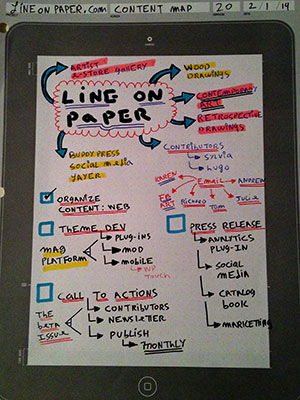
- Organize Web Content
- Theme Development
- Magazine Platform
- Call To Actions
- Press Release
The L.O.P design study series is a comprehensive overview of essays aimed at documenting the entangled & exciting process of web design. Describing each fundamental project road map for developing Line On Paper magazine. In part one, a brief overview on working with high-resolution images for the purposes of web output are discussed. While describing general goals for the magazine and pontificating on front end web tools. Our aim is to launch the magazine during the second quarter of 2014, with incremental monthly releases. Documenting the entire project roadmap for Art Journal as a form of feedback & resource mechanism for the DIY creative designer.
Part One
Organizing Web Content
 What is the preferred time table for designing a comprehensive online magazine exhibiting contemporary art.? One that is intended to function as a service for visual artist & a publishing platform for the creative community. The L.O.P | Design Study series for Art Journal will attempt to bring this question to light. This week we are focusing on organizing web content, including workflow practices. The essay series is intended to be seen as a progression towards developing the entire project (line on paper magazine) from the ground up using lean start-up methodologies.
The goals for the upcoming online magazine project will be to sustain and exhibit contemporary visual artist and their works. While engaging an open-ended conversation and building a community of Think Tanks. Creatives with a focus on discussing historical art criticism, the state of the art world and its entangled ways of promoting contemporary art. Including a comprehensive gallery exhibition series. Curated monthly by a panel of contributors working across multi disciplinary media on paper, canvas, print, photography, digital media and illustration design.
Good journalism is to the NY times as art images is for Line On Paper magazine. As we are in the process of editing hundreds of artistic reproductions expanding across decades. In some areas; dating back to the late 1990’s to present time. Editing such extensive simulacrum, representing zeros & ones inside a massive two terabyte external drive containing volumes of visual art is the first step in organizing web content for the magazine. The workflow or modus operandi is quite simple and is a basic guideline for any web design process requiring the editing of print related material for web output. One that is both optimal in terms of site speed and responsive in how it functions across an array of multiple screens.
- Resizing (tiff) scanned files at (1600dpi) or dots per inch within a CMYK color mode to sRGB web values
- Adding adjustment values to each image using Photoshop CS6
- Using the “Save for Web” feature (PS) as step one in scaling down for adding responsive sliders within a responsive design workflow
- Generating additional batch resizing using ImageOptim App before adding images to a CMS for gzipWTF upload performance testing
Lastly, content curation must be taken into account for better user experience and site performance. In a traditional Fine Art gallery setting, there is a curator who usually gathers and researches a show before going live for public consumption. For our first issue entitled: “the beta issue” we feature a body of work ranging between works on paper drawings, digital mono prints, ephemera and collage. From a small yet dedicated team of contributors working across a variety of media. Including a comprehensive retrospective print catalog series from yours truly. In later monthly releases, the magazine will feature a thesis base system encompassing a different digital curator each month. Always promoting visual ideas in a way that is transparent and pushes the exhibition of original and though provoking contemporary art.
On the subject of site performance in relation to developing a CMS magazine platform there are a few online tools I do rely upon. ImageOptim as a second choice after using Photoshop “save for web” feature and gzipWTF . Imageoptim as you can imagine optimizes images, taking less disk space and loads faster by finding compression parameters. And removes unnecessary comments and color profiles which can cause any image intensive site to slow down. GzipWTF is better explained in their own words:
is the easiest f***ing way to check for gzip and more. The purpose of this site is to aide web designers & developers in speeding up sites by pinpointing which resources are not being gzipped by the server, which resources are slow and which resources are causing 404s. Our mission is to increase awareness of site speed as an important part of the web’s future. George Washington approves
Next Steps
Why do we blog about the actions of doing & the process of projects?
Eric Ries
chants the following tidbit:
The beauty of the blog-first startup is that it allows the entrepreneur to: validate ideas with minimal effort, identify potential customers, build a following and gather early user feedback. There is no best method for gathering feedback and validating startup ideas, but adding a blog to your lean startup toolbox and before writing code, consider writing a blog post.
Art Journal Fan Page

A powerful depository of creative ideas from the stimulating design shop of Creative Think Tank DC. CTTDC is a visionary design agency focusing on exploring the culture of creative ideas. Created & developed by DSC: A freelance web designer with a background in Fine Arts & Digital Media.


 Arts Journal Zine
Leave a comment