
“In Societies Where Modern Consumption Prevails, Life Presents Itself As A Giant Spectacle”
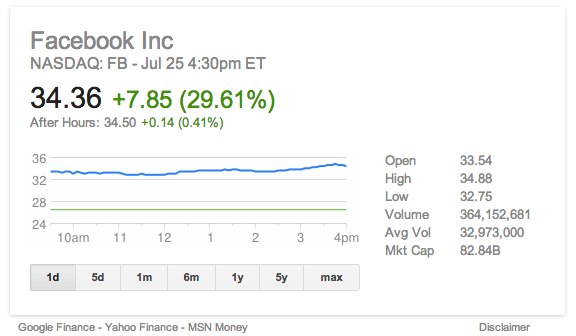
Charley Rose seminal interview with CEO and founder of Facebook Mark Zuckerburg was a brilliant insight prior to the company announcement of going public a few years ago. And yet when the IPO when public little over a year ago at 38$ and then plummeted to the low teens, the question of monetization loomed in. The company responded by paying over one billion for social photo sharing giant instagram, hoping we would see a new product emerged by the acquisition. Yet the big news this week has been the resurgence of the stock to close today at 34.36 per share.
Still low of its initial IPO offering of 38$
But why now?
Wall Street analysts expect the company to post earnings of $0.14 per share on revenue of $1.62 billion, up from $0.12 per share on $1.18 billion in revenue from the same quarter a year ago. After scouring the numbers, the key question beyond “the why proposition” will be how the company is monetizing its massive mobile user base. Its no surprise how FB makes its earnings based on a per user basis. As its algorithms are designed to fetch data based on the information we provide. Status updates, likes, check ins and comments are all data driven tools for FB advertisers as a information gathering social platform. And as the effects of the instagram purchase are yet to be seen, FB mobile strategy is one big reason Wall Street is talking about it and reports to “Buy” the stock are now showing up as well.
Facebook biggest assets from my vantage point as a web designer are evident between two fundamental points of view. The mobile strategy for ad placement and its giant information gathering system based on user input and behavior.
The Phone Value Proposition
In a nod to developing nations like India and Brazil, FB mobile strategy which is designed to make FB accessible on technologically humble feature phones including its own smart phone is the major asset for the company moving forward. FB which already boast more than 1.1 billion users now targets more than 100 million users who access the site on feature phones–dumbed down devices that cost as little as US20$ with the exception of iphone and some higher end Android models.
The big data fetch for advertisers is mobile.
Feature phones are popular in India, Brazil, Indonesia and Mexico, among others–countries that are now viewed as the fastest growing market for the internet and social networks. Last year, FB made tweaks to cater to iphone and Android users, improving mobile access and introducing new advertising methods. Alas, iphone and Android using countries already have extremely high FB penetration, leaving emerging markets as the new focal point. As these emerging markets will make their penetration towards the internet and sales on a phone instead of desktop.
Facebook spend an estimated $70 million to acquire Snaptu, an Israel-base company specializing in tailoring ads, including FB for use on even the most basic mobile phones.
The Closing Bell
For me, the fundamental query as a content creator is how to utilize FB as a platform and discovery mechanism for branding and discovery. Finding creative and innovative ways to monetize based on user experience, behavior and low-fi brand marketing should be the goal for any creative agency who wishes to take their products into the twenty first “ad sale” century. We have seen evidence of this movement in companies like Zynga and the now well establish FB app ecosystem. Making our content available beyond the desktop as we move forward beyond a flash based ecosystem is the big selling point for us all.
Next Steps
Subscribe To Our Newsletter Fan Page:

Subscribe Today!
Your daily source of creative inspiration in art, design, technology and culture. Help spread our grassroots art journal magazine by sharing and telling a friend. We look forward in hearing from you on or Fan Page or in the comments below.
 Arts Journal Zine
Leave a comment