
Culture Critique
Art in the 21st Century is a contemporary framework containing three fundamental foundations. The history of modern art in relation to appropriation, culture critique and the publishing of our upcoming magazine: Line on Paper. Featuring a collection of contemporary artist working across interdisciplinary art media. We begin by describing the history of modernism in explaining the didactic relationship between the “modern” vs “post-modern” contexts. While appropriating on Goya’s prints “Los Caprichos” as the quintessential precursor to modern art. Lastly, we develop a basic thesis behind making art in the 21st Century with our upcoming Fall issue entitle: The Beta Issue. A cosmical exploration between the idea of using forms + surfaces as a visual language in art.
“Next stop, broadcast television! Our flagship series, ART21 Art in the Twenty-First Century, returns to PBS this October for a season 7 premieres on Friday, October 24 at 10 p.m. ET. The new season features twelve artists—Tania Bruguera, Abraham Cruzvillegas, Leonardo Drew, Omer Fast, Thomas Hirschhorn, Elliott Hundley, Katharina Grosse, Graciela Iturbide, Joan Jonas, Wolfgang Laib, Trevor Paglen, and Arlene Shechet—across four episodes”.
—Jonathan Munar
—Art21
Chasing Modernism
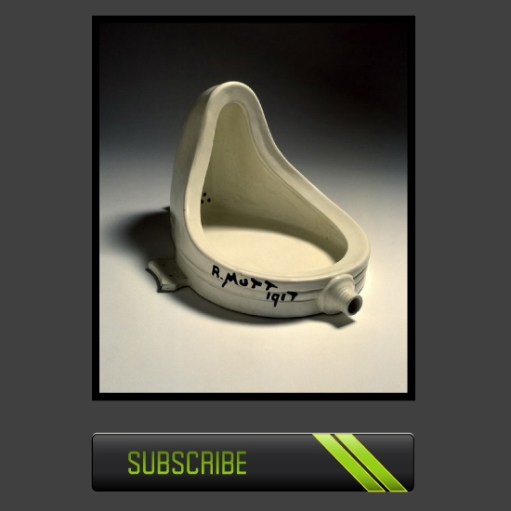
The history of modernism and appropriation in the arts did not begin with the introduction of Marcel Duchamp sculpture entitle “Fountain” to the French art academy in 1917, as we shall explore later in the essay. The PBS series “Art In The 21st Century” is a fantastic series for those of you wishing to understand the process of artistic creation and appropriation within the ecosystem behind the artist mind. Art in the 21st Century explores visual ideas which are grounded in social theory, art history and the culture of contemporary art. The concept behind the evolution of modernist art at the beginning of the early 20th Century is fundamental, in understanding our present noun. With a noted bent towards post-modernis tendencies after the second world war are noted examples in displaying a tectonic shift in ideas and attitudes for the visual creative working today
The early beginnings behind the evolution of modernity and appropriation in art began with the introduction of collage by Pablo Picasso after the invention of cubism. The idea of using collage in painting, drawing and sculpture came to Picasso during the second decade of the 1900’s. Making art pieces gathered from found objects, newspapers, used and discarded scrap metal materials. Duchamp simply borrowed the idea that art could arise from everyday materials and instead of constructing art, he simply appropriated the fountain as a work of art.
Thus creating a monumental taxonomy of valuable information towards the understanding behind art practices and methods. Which are grounded today within the convoluted world (as seen by the masses) of contemporary art. Both in terms of its history, undercurrents and value proposition for those in the business of selling, exhibiting and critiquing. But first, let us describe our thesis by outlining what is meant when we simply ask the question:
What Is Modern Art?
Occasionally in the life of a great artist some event, or some achievement, marks a turning point in his career. The publication of Los Caprichos, eighty plates, roughly 12 by 8 inches long where created in 1799. Despite this less than earth-shaking figure, the prints were not only Goya’s largest graphic work to date. While he was already fifty-three years old. At an age when most artist are at the height of their career, he was only beginning to show his mastery of drawing, tone and intellectual discourse. To be sure, he was one of the court painters for Los Carlos IV, but had he died before the drawings for Los Caprichos were made. He would today be rated as an attractive painter of the pre-Revolutionary era, and in graphics as mainly a reproductive etcher—
not the major artist and the father of modern art which he had started to become.
Within the art historical framework by which we begin to appropriate Goya as the early father of modern art, only second to Cezanne and Picasso. And it is because Goya’s method of creation for Los Caprichos appears to us as lost, within contemporary translation. Meaning, the subject matter of these etchings is embedded in such tactical coded language, both in relation to its composition and the notion behind the “sacred” artist working behind the curtains. Revealing, critiquing and reacting against tidal forces which have been posted in from of him. When certain kinds of observations become a malice of the tongue within a historical black list of lies, Goya manifested his true nature in exposing certain undeniable truths about the nature of his observers.
A true modern thinker.
One important historical description to note when viewing these images is to say when the first edition was ready for publishing, Goya sat back with anxiety. In anticipation to see what the public reception of his work would be. The reason one knows that he was apprehensive is that he changed his idea for the opening plate. Originally he intended what is now the masterpiece etching entitle: “The Sleep Of Reason Produces Monsters” for this position since it shows the artist himself. Although his face is hidden and what appears to be suffering from diabolic visions of his anguish brain, which is deliberative deceptive in visual hyperbole.
Goya probably feared the source of his inspiration might be discovered and lead him into trouble with the political as well as clerical “bruts” to whom the very name of Rousseau was then anathema. There proved to be ample grounds for Goya’s evasive action for the elusive nature behind the captions beneath each plate. Except the first for which half a dozen or more contemporary manuscript explanations exist today and are described below each image plate within the essay.
The gallery plates, as seen below are twelve selections from the original portfolio beginning with the most important print of all: “The Sleep Of Reason Produces Monsters”. Each print represents a tragic scenario culled from the artist observation between reality, critique and high-end drama.
Los Caprichos | X12
Twelve Selections From Goya’s: Los Caprichos portfolio print series:
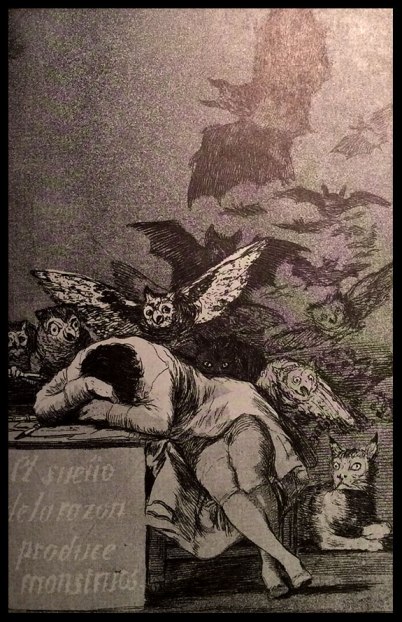
Imagination abandoned by reason produces impossible monsters:united with her, she is the mother of the arts and the source of their wonders.
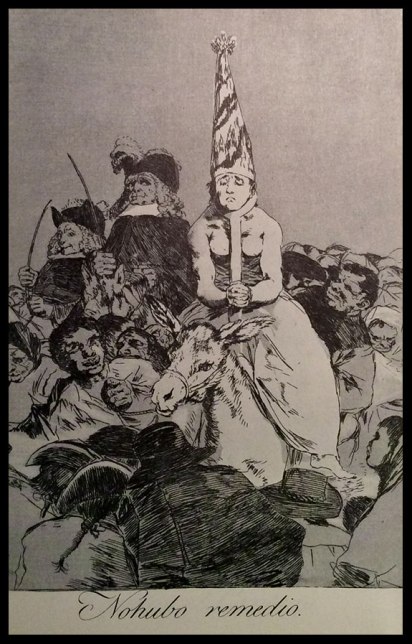
They are persecuting this saintly woman to death! After having signed her death sentence, they take her out in triumph. She has indeed deserve a triumph and if they do it to insult her they are wasting time.
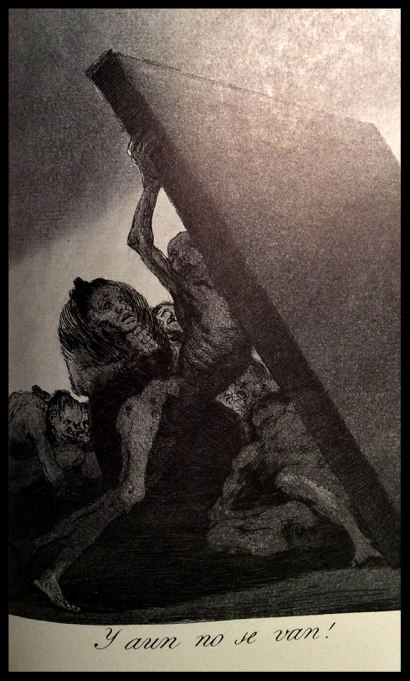
He who does not reflect on the inconstant of fortune sleeps peacefully while surrounded by dangers; he does not know how to avoid the danger which threatens him, and there is no misfortune which does not surprise him.
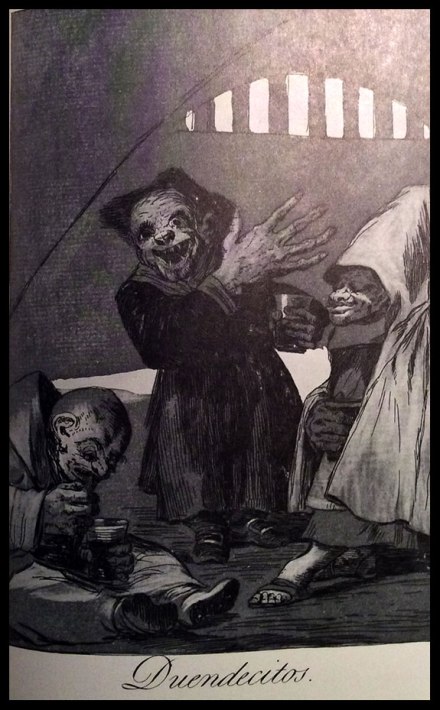
Now this is another kind of people. (Mammals) Happy, playful, obliging; a little greedy, fond of playing practical jokes; but they are very good-natured little men.
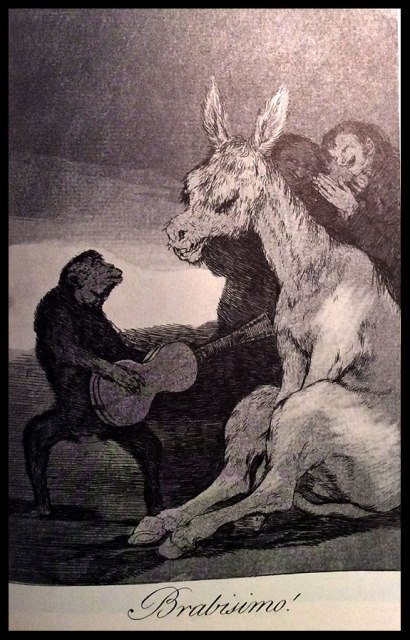
If ears were all that were needed to appropriate it, no one could listen more intelligently; but it is to be feared that he is applauding what is soundless..
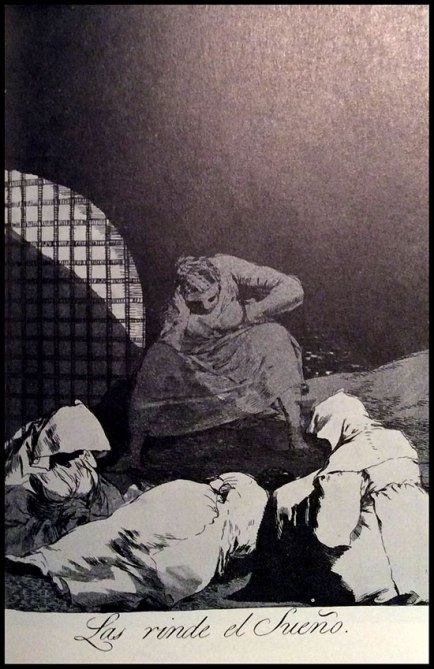
Don’t wake them! Sleep is perhaps the only happiness of the wretched.
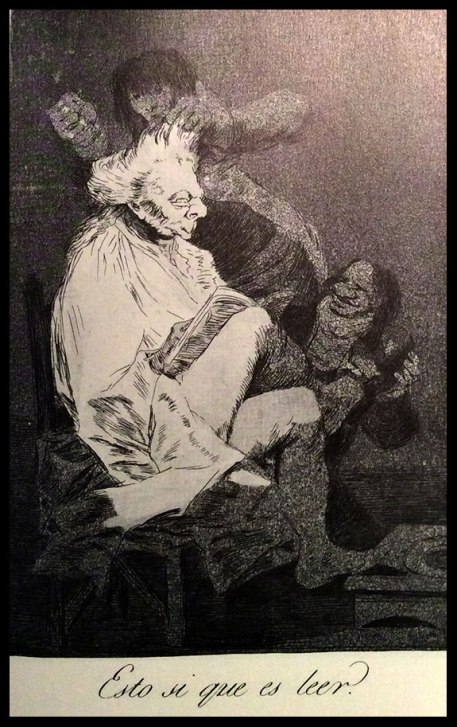
They are combing his hair, they are putting on his shoes, he is sleeping and he is studying . No on shall say he is not making the most of his time.
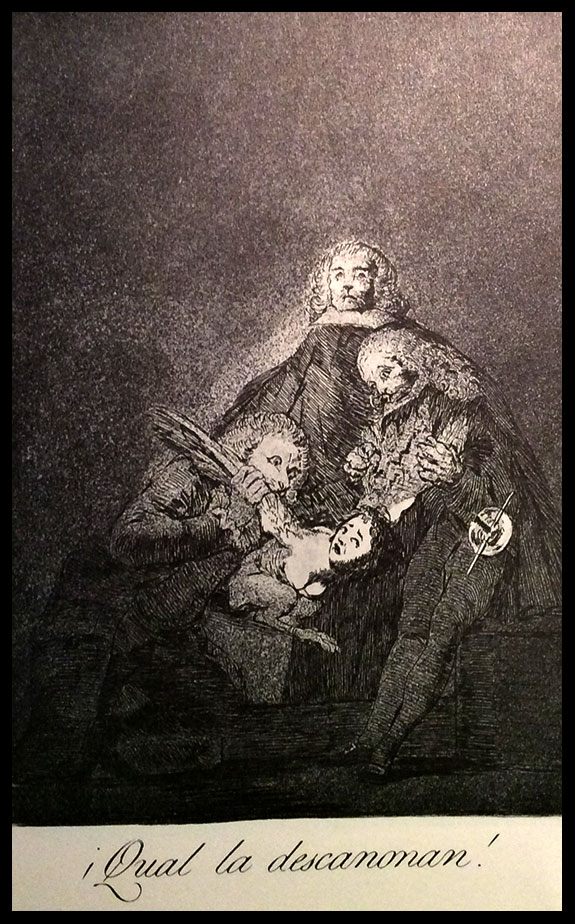
Hens (pretty lasses) also encounter birds of prey to pluck them and that is why the saying goes: you’ll get as good as they give.
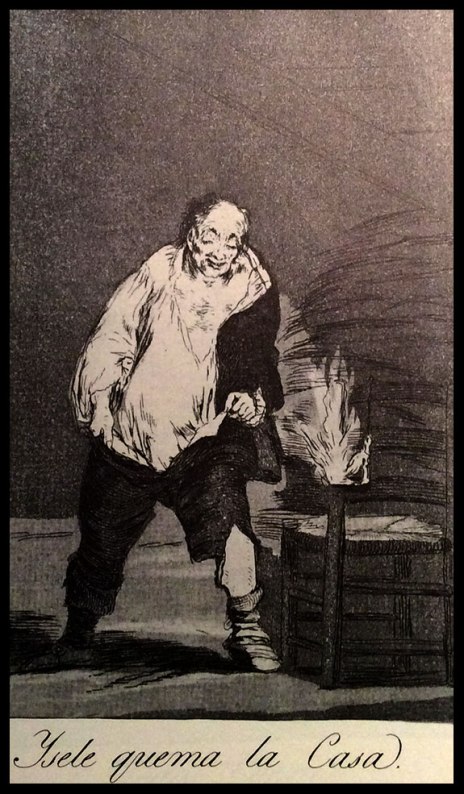
It will not occur to him to take off his breeches or to stop talking to the candle, until the local fire brigade freshens him up
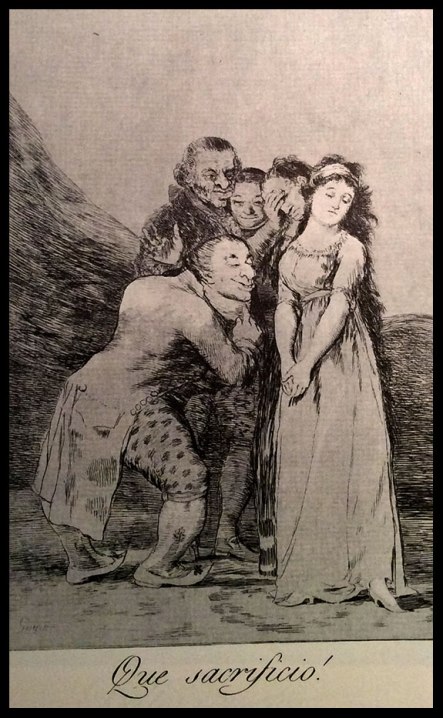
That’s how things are! The boyfriend is not very attractive and middle aged, but he is rich! and at the cost of the freedom of an unhappy girl, the security of a hungry family is acquired.
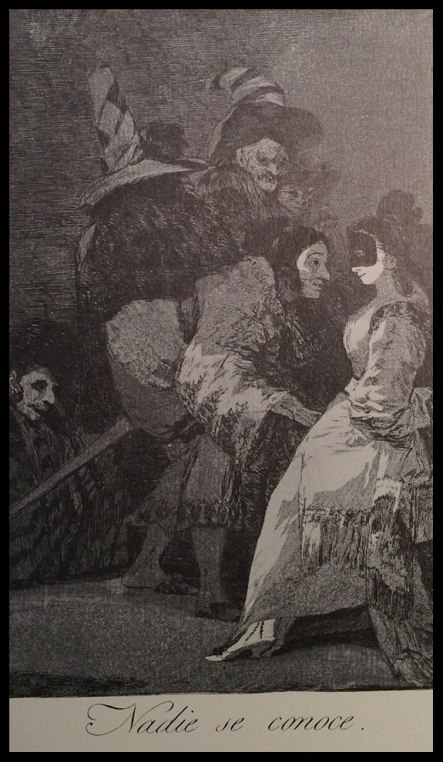
The world is a masquerade. Face, dress and voice, all are false. All wish to appear what they are not, all device and do not even know themselves.
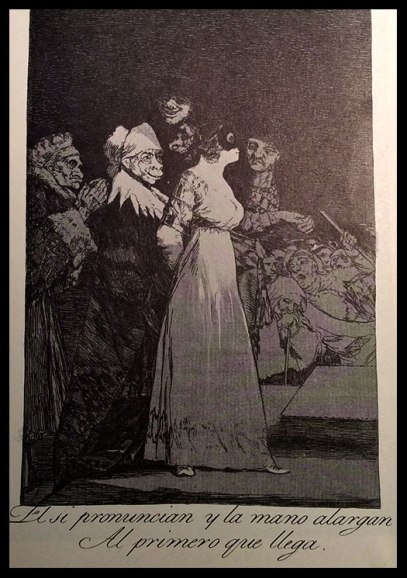
The readiness with which many women are inclined to get married, hoping thereby to be able to live greater liberty.
We can create a category archive in describing the history of modern art between the periods of 1900-1945 and post modernism respectively from 1970-1990 as is described by most art historians these days. The attitudes and ideals behind modern art is to reflect the nature of its time, using art as a reflective double sided mirror between the artist perception and our current industrial complex behaviors.
The basic idea to grasp in modern art is to say:
“yes, life is chaotic, disturbing and convoluted at times. And these pictures are meant to be seen as the explanation behind the ideal optimism which is the true nature of any modern metropolis.” If you where to take a class in art history during the early part of the 20th Century, such an explanation would have been provided as a method of comprehension in describing “Fountain” “The Joy of Life” by Matisse and certainly Picasso’s “Les Demoiselles d’Avignon”. to the masses.
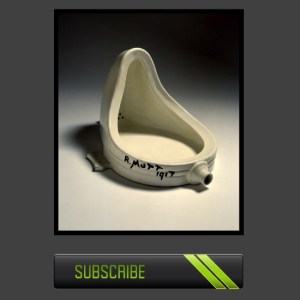
Furthermore,the Tate Modern in the UK describes Duchamp “Fountain” as:
“Fountain is one of Duchamp’s most famous works and is widely seen as an icon of twentieth-century art. The original, which is now lost, consisted of a standard urinal, laid flat on its back rather than upright in its usual position, and signed ‘R. Mutt 1917’. The Tate’s work is a 1964 replica and is made from glazed earthenware painted to resemble the original porcelain. The signature is reproduced in black paint. Fountain is an example of what Duchamp called a ‘readymade’, an ordinary manufactured object designated by the artist as a work of art. It epitomizes the assault on convention and good taste for which he and the Dada movement are best known.
The idea of designating such a lowly object as a work of art came from a discussion between Duchamp and his American friends the collector Walter Arensburg and the artist Joseph Stella. Following this conversation, Duchamp bought an urinal from a plumbers’ merchants, and submitted it to an exhibition organized by the Society of Independent Artists”.
How do we explain the tragic horror of war, drone killings, surveillance politics and the rise behind the military/police industrial complex? for the artist, as a social collector behind all things critical thinking, contemporary art is the perfect symbol for describing the modern epoch. A good friend and noted historian John Angeline would often teach us two valuable principles as a way of interacting between the two polar opposite realities of Modernism and Post Modernism. When you think about the nature of modern art ( Matisse, Miro, Picasso, Dali and Duchamp) the notion of matter must always be present in her mind; as “her” is narrated by the candid spirit of Gertrude Stein. Thus if modernism is best represented as matter, post modernism is anti-matter breaking away all realities behind the optimism behind modernity and is ideal absolutism.
In physics, anti-matter comes into being when its interaction with matter cancels each other in one infinite loop of particles. In art, the same principle takes place when post-modernism or anti-matter is later introduced in the observational game critique. The only true absolute behind what Christopher Hitchkens called “The End Of Irony” in a post nine eleven epoch is the argument posted by conceptualist of the 1970’s when they pontificated upon the following post-modern argument:
There is no need to try and explain the chaotic nature behind the modern metropolis. Art is simply a reaction to such observations and attempts to use ironic visual metaphors as a way of portraying these truths we must all face. Where the idea behind “art for art sake” is both matter, anti-matter and a double sided mirror soaked with inflammatory bird droppings. Art can be seen today as the paralysis of hope behind the nature of ourselves. A paralysis embedded between two noted simplistic modalities:
To be modern is to find optimism in art as an explanatory solution for hope. And thus, post-modernity makes fun, pokes, ridicules and exposes everyone’s dirty secrets.
Line On Paper Magazine
Art For The Next Century
The appreciation for process oriented work has returned in contemporary art with renew strength in the twenty first century. In the Fall, when we launch the The Beta Issue, which will feature the works of contemporary masters working within their own respective visual fields. Within painting, drawing, photography and works on paper which are highly personal in tone, nature and compositional framework. The noted author and art historian Pamela Lee, has written on the process of art making in our current contexts between what I see as dissolution, surveillance politics embedded within Orwellian contemporary dystopia. She writes regarding the process of art and drawing:
“Art is a process, is almost tautological, for nothing could seem more obvious than the way in which art registers the process of the artist making. Perhaps, however this notion of drawing in art as process should be seen as developing from specific moments in time and taste, rather than as a given.”
For those of us who enjoy observing the “faux” beach located within the shores of planet krypton.
Line On Paper magazine will attempt to explain the following value proposition to those of you who subscribe and read our publication:
- How do you monetize the culture of creative ideas?
- What is the relationship between our current epoch and the history of modern art?
- How do we describe the difference between tactical optimism while fostering online cultural critique groups? Specially when curating a complete commerce gallery service centered around curating online shows, with participating contributor support.
L.O.P along with our creative DIY social community is a clear solution for the modern thinker in all of us. We welcome those of you who have already Subscribe to the publication.
Sylvia O
The Transformative Power In Painting


Andrew Conti
Mental Maps


Hugo/Apex76
The Immutable Experience Of Portraiture


Paul H Ramirez
Forms + Installation Surfaces


Arturo Herrera
Post-Modern Surrealism


David S Concepcion
Gestural Abstraction Motifs


Next Steps
For Artist Sales Inquiries | Contact Art Journal
Gallery Commerce Platform | Fall 2014 | L.O.P


 Arts Journal Zine
Leave a comment